Introduction to Hefei City
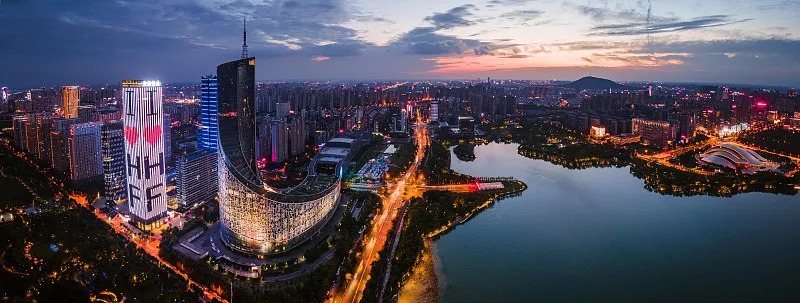
Hefei, known in ancient times as Luzhou and Luyang, is the capital of Anhui Province, a key central city in the Yangtze River Delta, a national comprehensive transportation hub, and the second comprehensive national science center approved for construction in China. It is widely acclaimed by the official slogan "Famous Lakeside City, Innovation Highland". The city gets its name from the fact that both the East Fei River and South Fei River originate here, with its name first recorded in Records of the Grand Historian: Biographies of Merchants. As early as the Western Han Dynasty, it was a commercial hub for the distribution of goods between northern and southern China, boasting a city construction history of more than 2,000 years.
From the Sui Dynasty to the Ming and Qing dynasties, Hefei served as the seat of Luzhou Prefecture, acting as the core administrative and military stronghold in the Jianghuai region (the area between the Yangtze River and Huaihe River). It has left a profound cultural heritage as the "Land of the Three Kingdoms, Hometown of Bao Zheng, and Cradle of the Huai Army". It is the birthplace of many historical celebrities, including Bao Zheng, an upright and incorruptible official of the Northern Song Dynasty; Li Hongzhang, a key minister of the late Qing Dynasty; and Liu Mingchuan, the first governor of Taiwan, bearing the profound deposits of the Three Kingdoms culture, incorruption culture, and Huai Army culture. In 1952, Hefei officially became the capital of Anhui Province. After decades of development, it has grown from a small Jianghuai town into a core growth pole of the Yangtze River Delta.
Hefei surrounds Chaohu Lake, one of the five largest freshwater lakes in China, with exceptional landscape and ecological advantages. At the same time, it takes scientific and technological innovation as its core development driver, leading the country in cutting-edge fields such as quantum information and nuclear fusion. It has achieved the perfect integration of a thousand-year-old ancient city and a sci-tech innovation new city, becoming a modern metropolis with profound historical heritage, ecological endowment, and innovative vitality.
Introduction to Famous Scenic Spots in Hefei
Sanhe Ancient Town
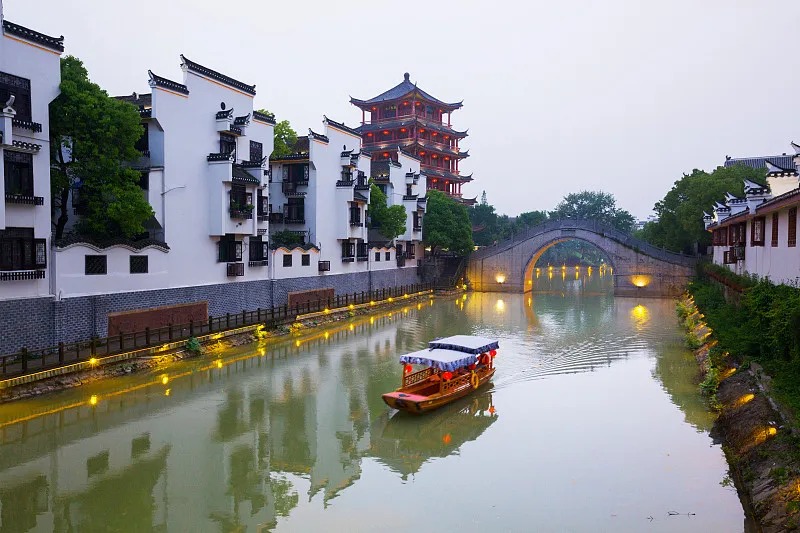
Located at the southern end of Feixi County, Hefei, Sanhe Ancient Town is named after the convergence of the Fengle River, Hangbu River, and Xiaonan River. It is the only national 5A-level tourist attraction in Hefei, with a history of administrative establishment of more than 2,500 years. Known in ancient times as Quezhu and Que'an, it is a prestigious water town in the Jianghuai region. With a profound historical heritage, it was a strategic military location for the conflict between the Wu and Chu states in the Spring and Autumn Period, and the main battlefield of the Great Victory at Sanhe of the Taiping Heavenly Kingdom in the late Qing Dynasty, leaving many historical relics such as the ancient city wall, ancient fort, and Prince Ying’s Mansion.
It is one of the important birthplaces of the Huai Army culture, and also the hometown of Chen-Ning Yang, the winner of the Nobel Prize in Physics. The Former Residence of Chen-Ning Yang in the ancient town completely preserves the scenes of his early life, showing the growth track of modern Anhui-born celebrities. The ancient town takes Huizhou-style water town architecture as its core feature, with uniform white walls, black tiles, and upturned horse-head walls. Ancient streets, alleys, and bridges are built along the water. Taking a sculling boat through the river channels, visitors can fully enjoy the gentle charm of the water town in central Anhui. At the same time, Sanhe has nurtured unique folk culture. Intangible cultural heritage items such as Lu Opera, Huachuan folk performance, and Sanhe feather fan have been passed down from generation to generation, while featured foods such as Sanhe rice dumplings and Sanhe rice wine have become representatives of Jianghuai food culture.
Bao Park
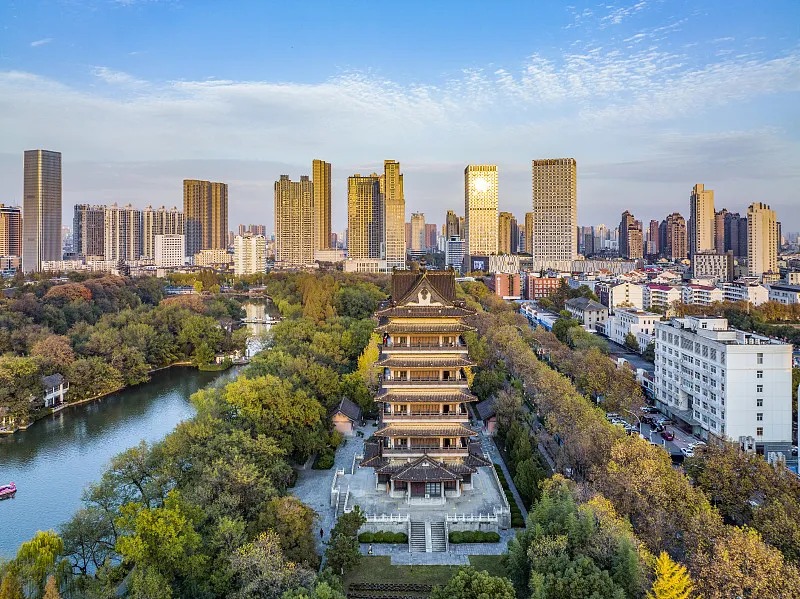
Located on Wuhu Road, Baohe District, Hefei, Bao Park is a national 4A-level scenic spot built to commemorate Bao Zheng, a famous upright official of the Northern Song Dynasty. It is also the core landmark of Hefei's urban cultural context, known as the "Beautiful Scenery of Baohe River", ranking first among the top ten scenic spots of Hefei. The park was first built in the 3rd year of the Zhiping reign of the Northern Song Dynasty (1066 AD), the origin of Bao Zheng memorial temples at home and abroad. After nearly a thousand years of renovation and expansion, it has now formed an incorruption culture-themed park consisting of four core landscapes: Bao Zheng Memorial Temple, Bao Zheng’s Cemetery, Qingfeng Pavilion, and Fuzhuang Garden, with a total area of 34.5 hectares, including 15 hectares of water area.
Bao Zheng Memorial Temple is located on Xianghuadun Islet in the Baohe River, which is said to be the place where Bao Zheng studied in his childhood. The temple completely preserves the Family Instructions of Bao Zheng, inscriptions of past dynasties, and historical relics, vividly showing the life of "Lord Bao" who was impartial, unselfish, upright and incorruptible. Bao Zheng’s Cemetery, across the river from the memorial temple, is the most well-preserved cemetery of famous ministers of the Song Dynasty existing in China, where the remains of Bao Zheng, his wife, and descendants are buried. The cemetery has a rigorous regulation, fully showing the solemnity and solemnity of official architecture of the Song Dynasty. The 42-meter-high Qingfeng Pavilion overlooks the whole park, matching the surrounding Huizhou-style garden scenery. For thousands of years, Bao Park has not only been a place for Hefei people to remember the sages, but also an important inheritance place of China's incorruption culture, allowing Bao Zheng's spirit of clean government and family-country feelings to continue from generation to generation.
Xiaoyaojin Park
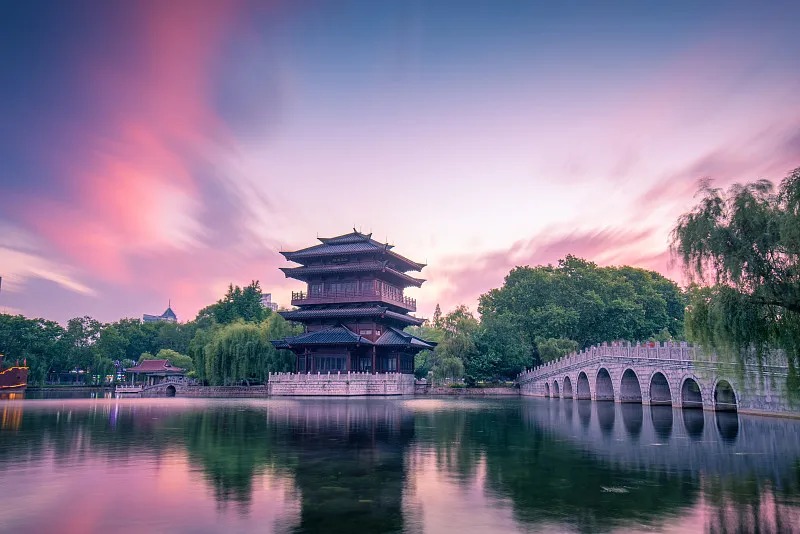
Located on Shouchun Road, Luyang District, Hefei, Xiaoyaojin Park is the oldest urban park in Hefei, as well as an important landmark of the Three Kingdoms culture, famous worldwide for the classic allusion of "Zhang Liao’s stunning victory at Xiaoyaojin". In ancient times, Xiaoyaojin was a ferry crossing on the Fei River, a military stronghold in the Jianghuai region. In the 20th year of the Jian'an reign of the Eastern Han Dynasty (215 AD), Sun Quan led an army of 100,000 to besiege Hefei, but Zhang Liao, a famous general of the Cao Wei regime, defeated the Wu army with 800 infantry, creating a classic battle example of winning a war with a smaller force against a larger one in the history of ancient Chinese warfare. This battle was recorded in the chapter of Romance of the Three Kingdoms, making Xiaoyaojin famous through the ages.
The park covers a total area of 31.3 hectares, including 11.2 hectares of water surface. The park completely preserves historical relics such as the Tomb of Zhang Liao, Xiaoyao Pavilion, and Feiqi Bridge. The Xiaoyao Pavilion fully shows the war history and humanistic style of Hefei during the Three Kingdoms period through cultural relics, murals and other forms. After thousands of years of changes, Xiaoyaojin has evolved from an ancient battlefield into the lung of the city, integrating the gentleness of Jiangnan gardens and the grandeur of northern gardens. The park is full of ancient trees and surrounded by clear water, with different scenery in four seasons, which is the urban memory passed down from generation to generation by Hefei people. Today's Xiaoyaojin is not only a cultural landmark bearing the historical context of the Three Kingdoms, but also an urban public space integrating leisure, entertainment and commemoration, realizing the perfect integration of historical heritage and urban fireworks.
Former Residence of Li Hongzhang
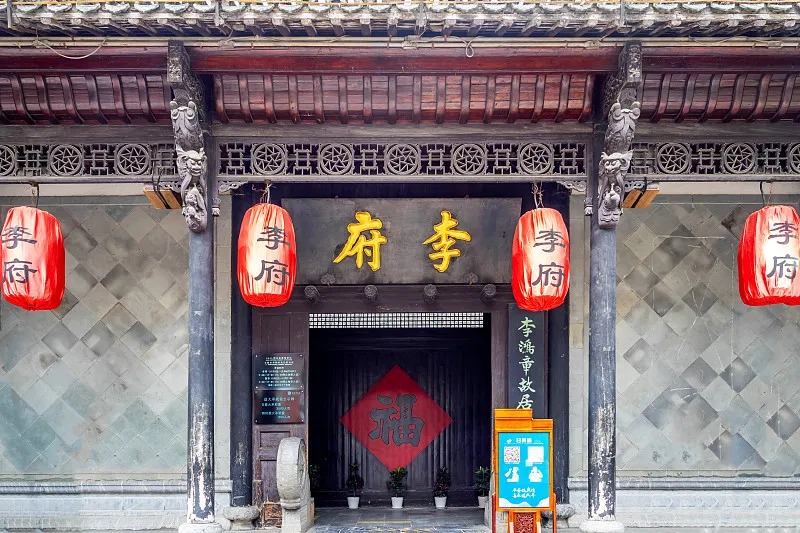
Located in the middle section of Huaihe Road Pedestrian Street, Luyang District, Hefei, the Former Residence of Li Hongzhang is the former residence of Li Hongzhang, a key minister of the late Qing Dynasty and founder of the Huai Army. It is also the largest and most well-preserved official-style residential building complex of the Jianghuai region existing in Hefei, and a national 4A-level scenic spot. The residence was first built in the Guangxu reign of the Qing Dynasty, originally a residential compound of the Li family. In its heyday, it covered an area of more than 2,000 square meters, known as "Half of the Street is the Li Mansion". Now it completely retains the core buildings such as the front hall, middle hall, and Zoumalou (Winding Corridor Building), fully showing the typical characteristics of residential architecture in the Jianghuai region in the late Qing Dynasty.
The whole building faces south with its back to the north, adopting the regulation of a five-courtyard complex, with a flush gable roof, black tiles and white walls, and exquisite and elegant carved beams and painted buildings. It not only has the solemnity and grandeur of northern official architecture, but also integrates the exquisiteness and agility of Huizhou-style architecture, making it a model of Jianghuai residential architecture in the late Qing Dynasty. The residence has two core exhibitions: the Life Exhibition of Li Hongzhang, and the Huai Army and Modern National Defense Exhibition. Through a large number of precious historical relics, photos and documents, they fully show the ups and downs of Li Hongzhang's life, as well as the complete development process of the Huai Army from its establishment to its development. As the core cultural landmark of Hefei, the "Cradle of the Huai Army", the Former Residence of Li Hongzhang is not only a precious relic of residential architecture in the late Qing Dynasty, but also a microcosm of modern Chinese history. It witnessed the arduous process of China's transition from tradition to modern times in the late Qing Dynasty, and also bears the profound memory of the modernization process of the Jianghuai region.
Anhui Museum
Located on Huaining Road, New Municipal and Cultural District, Hefei, Anhui Museum is a national first-class museum, the only provincial comprehensive museum in Anhui Province, and the core palace fully displaying the 8,000-year civilization history and Huizhou culture of Anhui. The new building of the museum was officially opened in 2011, with its architectural shape centered on the Huizhou-style architectural features of "five connected squares and water returning to the hall". It has a total construction area of 41,000 square meters, with a collection of more than 320,000 cultural relics, covering many categories such as bronzes, ceramics, calligraphy and paintings, jades, and lacquerwares. Among them, the Shang and Zhou bronze ritual vessels, Chu cultural relics of the Warring States Period, portrait stones of the Han Dynasty, the Four Treasures of the Study from Huizhou, and Huizhou-style calligraphy and paintings of the Ming and Qing dynasties are the most distinctive.
The treasure of the museum, the Chu Grand Ding, is a heavy bronze vessel of the Chu State in the Warring States Period, and also the largest existing round bronze ding vessel in China, representing the peak level of bronze casting technology in the pre-Qin period. The museum has permanent themed exhibitions such as Anhui Civilization History Exhibition, Huizhou Ancient Architecture, and Treasures of Jianghuai. Taking time as the vein, it fully shows the complete development process of Anhui from the Lingjiatan Culture in the prehistoric period, to the Huaiyi Civilization in the Shang and Zhou dynasties, and then to the Huizhou merchant culture in the Ming and Qing dynasties. As an important window of Anhui culture, Anhui Museum is not only an institution for cultural relics collection and protection, but also an important position for cultural inheritance and science education. Through rich exhibitions and social education activities, it makes the profound heritage of Anhui culture well known to more people, and has also become an important cultural landmark of Hefei.
Mingjiao Temple
Located on the Jiaonu Platform at the eastern section of Huaihe Road Pedestrian Street, Luyang District, Hefei, Mingjiao Temple is one of the oldest existing Buddhist temples in Hefei, and the location of "Buddhist Bell at Jiaonu Platform", one of the Eight Scenes of Luzhou, with a history of more than 1,500 years. The temple was first built in the period of Emperor Wu of the Liang Dynasty in the Southern Dynasties, originally named Tiefo Temple (Iron Buddha Temple), and renamed Mingjiao Temple in the Tang Dynasty. After repeated destruction and reconstruction, the current temple buildings were rebuilt in the late Qing Dynasty, and it is a National Key Buddhist Temple in China.
Mingjiao Temple is located on the Jiaonu Platform built by Cao Cao. The Jiaonu Platform was first built in the Jian'an period of the Eastern Han Dynasty. It was a military fortress built by Cao Cao to train crossbowmen to resist Sun Quan of the Eastern Wu. The platform is 5 meters high, with an area of nearly 4,000 square meters, with a history of more than 1,800 years, and is an important relic of the Three Kingdoms culture in Hefei. The temple still preserves historical sites of the Three Kingdoms period such as Wushang Well and Tingsong Pavilion. Wushang Well is named because its wellhead is higher than the ridges of the residential houses around the temple. The edge of the well still has traces of rope wear from water drawing in the Wei and Jin dynasties, making it one of the oldest existing water wells in Hefei. The overall building of the temple has rigorous regulations, and the Mahavira Hall is magnificent, with upturned eaves and carved beams, combining the solemnity of Buddhist temples and the agility of Jianghuai ancient architecture. With the morning bell and evening drum every day, the Buddhist sound is melodious. For thousands of years, Mingjiao Temple has integrated the military culture of the Three Kingdoms and Han Chinese Buddhist culture. It is not only the core place of Buddhist culture in Hefei, but also a cultural landmark bearing the thousand-year history of the city, witnessing the changes of Luzhou City over the years.
Crossing the Yangtze River Campaign Memorial Hall
Located on the shore of Chaohu Lake, Baohe District, Hefei, the Crossing the Yangtze River Campaign Memorial Hall is a large-scale red memorial venue built to commemorate the Crossing the Yangtze River Campaign in 1949. It is a national 4A-level scenic spot, as well as a National Patriotic Education Demonstration Base and a National Classic Red Tourism Scenic Spot. The memorial hall was officially opened to the public in 2012. The overall shape of the building is like two giant warships riding the wind and waves, facing Chaohu Lake with a magnificent momentum. It has a total construction area of 20,000 square meters, and the core exhibition area includes multiple themed exhibition halls such as the Pre-war Situation Hall, Campaign Preparation Hall, Campaign Breakthrough Hall, and Campaign Victory Hall, which fully show the whole process of the Crossing the Yangtze River Campaign.
The Crossing the Yangtze River Campaign in 1949 was the largest strategic campaign in the Liberation War of the Chinese People's Liberation Army. Yaogang Village in Hefei was once the seat of the General Front Committee of the Crossing the Yangtze River Campaign. Older generation proletarian revolutionaries such as Deng Xiaoping and Chen Yi commanded this campaign that determined the fate of China here, laying a solid foundation for the founding of New China. The museum has a collection of more than 2,000 cultural relics, including precious historical relics such as ships, weapons, telegrams, and martyrs' relics used in the Crossing the Yangtze River Campaign. Through scene restoration, multimedia demonstration, cultural relic display and other forms, it vividly restores the magnificent historical scene of "a million heroic troops crossing the Yangtze River". As an important red cultural landmark of Hefei, the Crossing the Yangtze River Campaign Memorial Hall is not only an important place to remember revolutionary martyrs and inherit the red gene, but also a core position for carrying out patriotic education and revolutionary tradition education, allowing the red spirit to be passed down from generation to generation.
Laoshan Island Scenic Area of Chaohu Lake
Located in Zhongmiao Street, Chaohu City, Hefei, and surrounded by Chaohu Lake, one of the five largest freshwater lakes in China, Laoshan Island Scenic Area is the core landscape of Chaohu Lake Scenic Area, known as "the Finest Scenery Between Lake and Sky". Chaohu Lake, known as Juchao and Nanchao in ancient times, has a humanistic history of thousands of years. It is said that King Tang of Shang exiled Jie to Nanchao here, making it the birthplace of lake-dwelling culture in the Jianghuai region.
Laoshan Island is the largest island in Chaohu Lake, with an area of about 0.86 square kilometers. It has three mountains and nine peaks, with the highest altitude of 115 meters. It is said that the ancient legend of "the submersion of Chaozhou Prefecture and the rise of Luzhou City" originated here, adding a strong legendary color to the lake and mountains. The core of the scenic area includes two major parts: Zhongmiao Temple and Laoshan Island. Zhongmiao Temple was first built in the 2nd year of the Chiwu reign of the Eastern Wu Dynasty (239 AD), with a history of more than 1,700 years. It is located on the north bank of Chaohu Lake, and is known as "Jiuhua Mountain in the south, Zhongmiao Temple in the north". The temple is built against the mountain and near the water, with upturned eaves and a magnificent momentum, making it an important religious and cultural site in the Jianghuai region. The Wenfeng Pagoda built in the Ming Dynasty is preserved on Laoshan Island, with a height of 51 meters, seven floors and eight octagonal sides, with a total of 135 steps. There are 802 brick-carved Buddha statues in the pagoda, making it the most complete ancient pagoda of the Ming Dynasty preserved in the Chaohu Lake Basin. The scenic area combines the natural beauty of lakes and mountains with the humanistic heritage of thousands of years. The misty and vast scenery of Chaohu Lake complements the ancient temples, ancient pagodas and myths and legends, and is the core carrier of Hefei's city card of "Famous Lakeside City".

 English
 French
 Spanish
 Russian
 Arabic
 Italy
Italy