Introduction to Harbin City
Harbin, also known as the Ice City, is the capital of Heilongjiang Province and a key central city in northeast China. It serves as China’s core gateway to Northeast Asia, renowned as the "Oriental Moscow" and "Paris of the East", and is a world-famous city of ice and snow culture. Nestled in the northeastern part of the Northeast Plain and along the middle reaches of the Songhua River, the city is traversed by the Songhua River, nurturing an ecological pattern where the river and city coexist in harmony, with forests and waters intertwined. It is cloaked in a pristine silver blanket of snow in winter and offers cool and pleasant weather in summer, making it a rare tourist destination in China with dual peak seasons in both winter and summer.
Harbin’s modern urban history began in 1898 with the construction of the Chinese Eastern Railway, which transformed the former fishing village along the Songhua River into a rapidly rising commercial and cultural hub of modern northeast China. At its peak, dozens of countries established consulates here, and tens of thousands of foreign nationals settled in the city. European-style architecture and a way of life blending Chinese and Western elements took root here, shaping the city’s unique and distinctive European flair. Meanwhile, Harbin is a city with a glorious revolutionary heritage. It was one of the first cities in China to spread Marxism and witnessed the epic struggle of the Northeast Anti-Japanese United Army. After the founding of the People’s Republic of China, it became a vital national industrial base, living up to its reputation as the "eldest son of the People’s Republic" and making indelible contributions to the establishment of China’s complete industrial system.
Today, ice and snow culture has become the core calling card of Harbin, with iconic IPs such as the Harbin Ice-Snow World and Sun Island Snow Sculpture Art Exposition renowned worldwide. The century-old Central Avenue, Saint Sophia Cathedral, and China Baroque Historical and Cultural Block fully preserve the city’s century-old cultural heritage. Russian-style Western cuisine, northeast Chinese folk customs, and the cultures of indigenous ethnic groups including the Manchu and Hezhe are deeply integrated, forging the city’s unique temperament that combines exotic romance with authentic local life.

Introduction to Harbin’s Famous Scenic Spots
1. Central Avenue
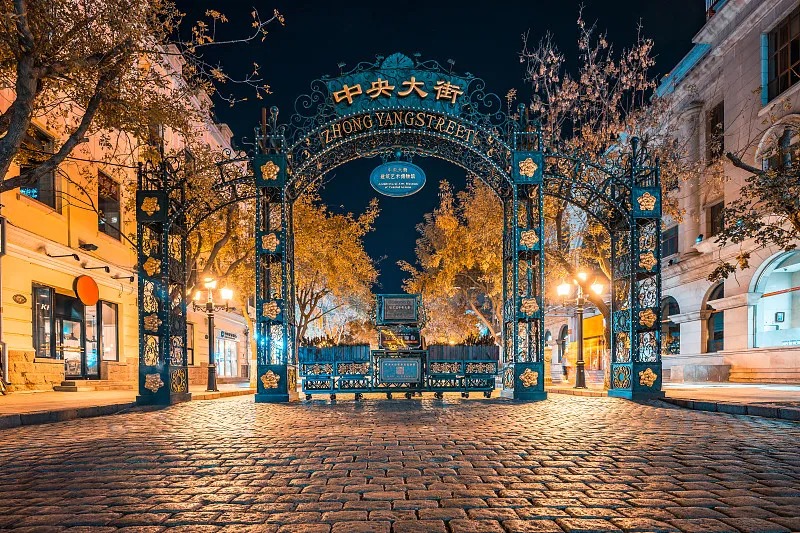
First built in 1898 and formerly known as China Avenue, Central Avenue stretches 1,450 meters from the Flood Control Victory Memorial Tower by the Songhua River in the north to Jingwei Street in the south. It is the iconic calling card and cultural landmark of Harbin, honored as the "Oriental Champs-Élysées" and "Asia’s No.1 Street". The entire street is paved with hundreds of thousands of granite "bread-shaped cobblestones", which remain flat and intact after a century of wind and rain, making it a rare well-preserved century-old pedestrian street in China.
Known as "a gallery of international architectural art", Central Avenue is lined with 71 European and European-style buildings on both sides, covering a variety of architectural styles including Renaissance, Baroque, Eclecticism and Art Nouveau, with 13 of them listed as municipal-level protected buildings. Over the past century, it has witnessed the cultural collision between China and the West brought by the construction of the Chinese Eastern Railway. It is home to century-old time-honored brands such as the Modern Hotel and Huamei Western Restaurant. Here, Russian-style Western cuisine, Modern popsicles, characteristic northeast Chinese delicacies are intertwined with street accordion performances, forming a unique cultural trait that blends European flair with the authentic hustle and bustle of northeast China. Today, Central Avenue is not only a national AAAA-level tourist attraction and a national model pedestrian street, but also a living fossil of Harbin’s urban history, carrying the cultural memory of the century-old Ice City.
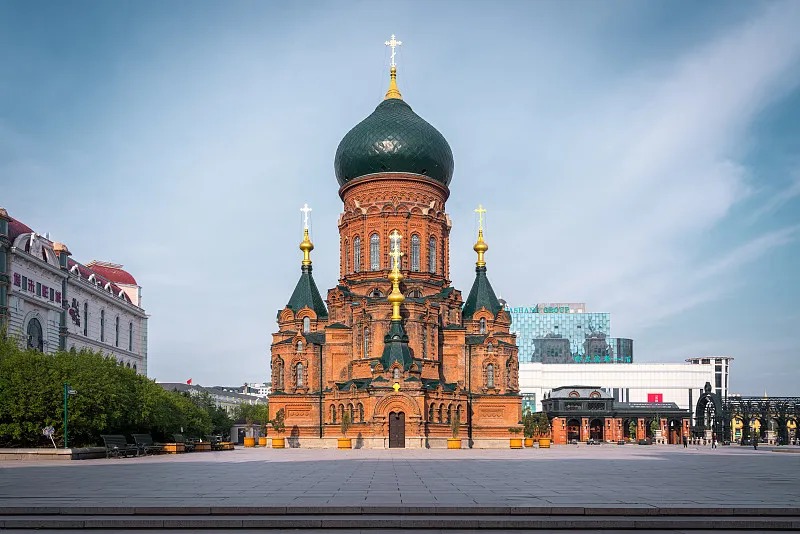
2. Saint Sophia Cathedral
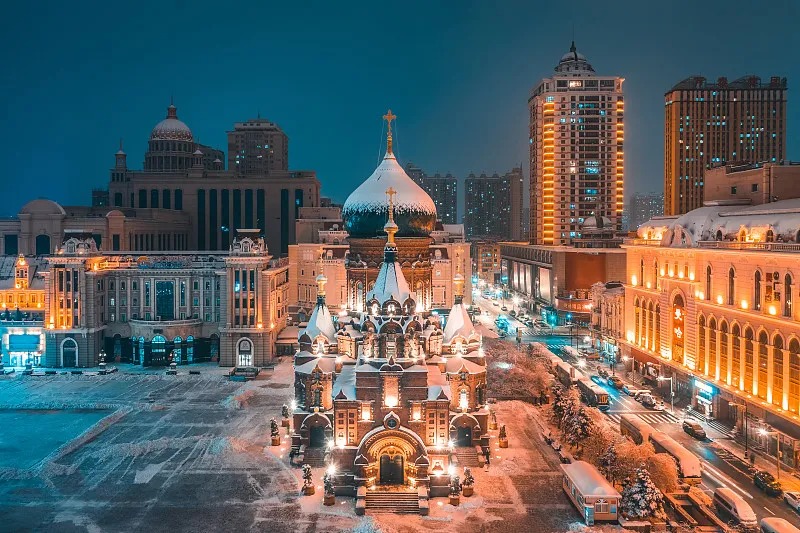
First built in 1907, Saint Sophia Cathedral was originally a military church for the 4th Infantry Division of the Transbaikal Military District of Tsarist Russia. Reconstruction began in 1923 and was officially completed in 1932. It is the largest and best-preserved Byzantine-style Eastern Orthodox church in the Far East, listed as a Major Historical and Cultural Site Protected at the National Level in 1996, and is an irreplaceable urban symbol of Harbin. The cathedral has a total height of 53.35 meters and covers an area of 721 square meters. Its main body is built with red bricks, matched with a huge green onion-shaped dome, supplemented by four tent-shaped roofs of different sizes scattered around. It perfectly replicates the classic form of Byzantine architecture with "centralized layout and dome as the core", combining the massiveness of traditional Russian architecture with the solemnity of Eastern Orthodox architecture.
Over the past century, Saint Sophia Cathedral has witnessed Harbin’s development from a border fishing village to a modern city, and recorded a hundred years of Sino-Russian cultural exchanges. Today, the interior of the cathedral has been transformed into the Harbin Architectural Art Museum, which systematically displays precious historical materials, old photos and architectural models of Harbin’s urban development history, and elaborates the historical context of the city’s rise with the Chinese Eastern Railway and its prosperity through the integration of Chinese and Western cultures. Piano concerts, architectural art exhibitions and other cultural events are held all year round in the cathedral square. When night falls, the cathedral against the lighting is like a fairy tale castle, and the white doves on the square complement the melodious music, making it the most representative exhibition window of Harbin’s European culture.
3. Sun Island Scenic Area
Located on the north bank of the Songhua River, facing the main urban area of Harbin across the river, Sun Island Scenic Area covers a total area of 88 square kilometers. It is a national AAAAA-level tourist attraction, a national scenic spot, and an all-season urban ecological landmark of Harbin. The name "Sun Island" is derived from the transliteration of "Taiyi'an" in the Manchu language, meaning "a land abundant with bream and whitefish". As early as the Qing Dynasty, it was a fishing and hunting resort along the Songhua River. In modern times, with the construction of the Chinese Eastern Railway, it became a summer resort for Russian expatriates, gradually forming a cultural heritage integrating Chinese and Western elements.
With "ecology, ice and snow, and humanity" as its core, the scenic area presents a natural landscape of coexisting rivers, lakes, islands and forests in summer, with vast wetlands and lush green trees. Landscapes such as Swan Lake, Sun Lake and Squirrel Island form an ecological picture of the river city in northern China. The Russian-style Town fully restores the Russian rural style, showing the century-long history of non-governmental cultural exchanges between China and Russia. In winter, Sun Island is the core position of Harbin’s ice and snow culture. The Sun Island Snow Sculpture Art Exposition, which started in 1988, is the oldest snow sculpture art event in China. Every winter, nearly a hundred craftsmen carve ice and snow into magnificent art groups, which are perfectly integrated with the natural scenery, making it a benchmark of world snow sculpture art, and known together with the Ice-Snow World as the "twin gems of Harbin ice and snow".
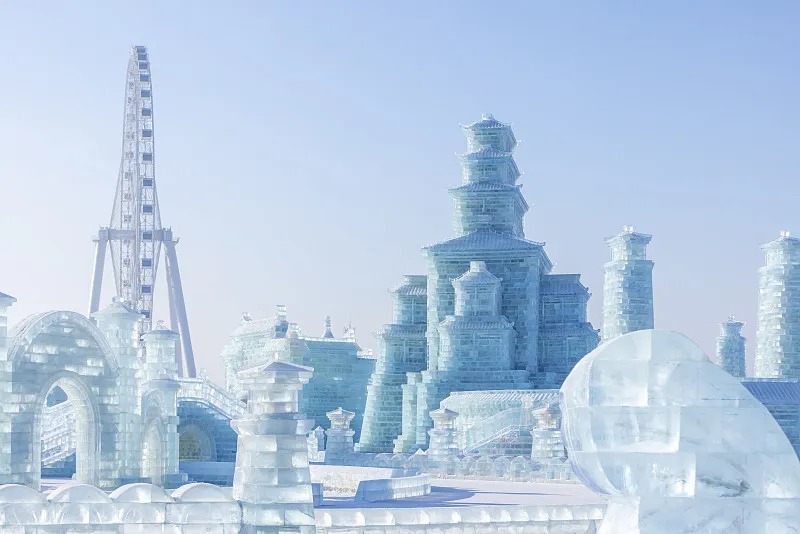
4. Harbin Ice-Snow World
First founded in 1999, Harbin Ice-Snow World is a large-scale ice and snow art project launched by the Harbin Municipal Government to welcome the Millennium Celebration. After more than 20 years of development, it has become the world’s largest ice and snow theme park with the highest artistic level, recognized by the Guinness World Records as the "World’s Largest Ice and Snow Theme Park" in 2024. It is the core carrier of Harbin’s "Crown of Ice and Snow" city brand. Located on the north bank of the Songhua River, the park opens every winter, with a total area of more than 800,000 square meters. It is built by nearly 10,000 craftsmen over several months, with ice and snow consumption both exceeding 100,000 cubic meters.
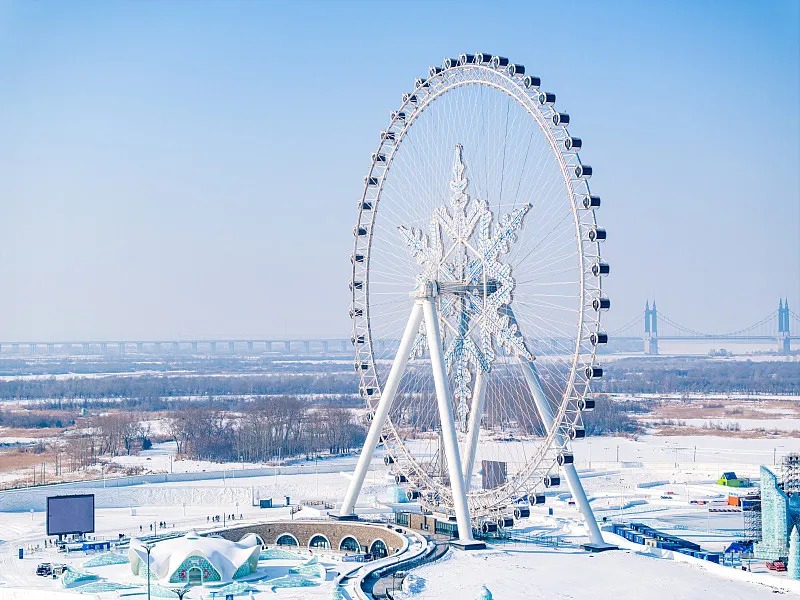
As a comprehensive embodiment of China’s ice and snow culture, Ice-Snow World creates more than a thousand ice and snow buildings and sculptures around different themes every year, integrating world classic landmarks, traditional Chinese culture, and regional characteristics of Heilongjiang into ice and snow art. Giant ice towers, ice and snow castles, and themed ice sculpture groups are scattered in the park, looking like a crystal clear palace in the daytime, and turning into a colorful glazed illusion at night under the rendering of thousands of colored lights. The park has a full range of experience projects such as the super ice slide, Snow Ferris Wheel, ice and snow maze, and cold region hot spring, matched with diverse contents including ice and snow performances, New Year’s Eve ceremonies, and folk activities, perfectly integrating ice and snow art, ice and snow entertainment, and ice and snow culture. It has not only reshaped the pattern of winter tourism in northern China, but also brought Harbin’s ice and snow culture to the world, becoming one of the most influential IPs of winter tourism in China.
5. China Baroque Historical and Cultural Block (Laodaowai)
Commonly known as Laodaowai, the China Baroque Historical and Cultural Block is located in Daowai District of Harbin. It is the birthplace of Harbin’s urban history, and the largest and best-preserved existing China Baroque architectural complex in China, with a total area of more than 500,000 square meters. It is the cradle of Harbin’s national industry and commerce, and a unique model of the integration of Chinese and Western architectural culture. The history of the block can be traced back to the early 20th century. With the construction of the Chinese Eastern Railway, a large number of Chinese national industrial and commercial businessmen took root here. They absorbed the decorative essence of Western Baroque architecture and combined it with traditional Chinese courtyard culture, creating a unique architectural style of "China Baroque".
The most distinctive feature of this architectural style is "shop in front, residence at the back, Western style outside, Chinese style inside". The street-facing facades adopt Baroque-style gorgeous carvings, arch structures, and dome decorations, fully showing the grandeur of European architecture; while the interior is a traditional Chinese courtyard-style quadrangle dwellings, with grey bricks and tiles, carved beams and painted rafters, integrated with Chinese auspicious patterns such as bats, pomegranates, and peonies, embodying the good wishes of Chinese businessmen. Over the past century, a large number of century-old time-honored brands such as Zhang Bao Pu Steamed Bun Shop, Laodingfeng, and Fan Yongji were born here, witnessing the rise and fall of Harbin’s national industry and commerce, and preserving the most authentic northeast Chinese folk customs and local life. Today, the block is not only a Major Historical and Cultural Site Protected at the National Level, but also a living museum of Harbin’s local culture, fully retaining the urban texture and life atmosphere of a century ago, and a core place to explore the root of the Ice City’s local culture.
6. Harbin Confucian Temple
First built in 1926 and completed in 1929, Harbin Confucian Temple is located in Nangang District of Harbin, covering an area of 23,000 square meters with a building area of 5,674 square meters. It is the largest, highest-grade and most complete existing Qing-dynasty-style Confucian temple in northeast China, a Major Historical and Cultural Site Protected at the National Level, and is known as one of China’s Four Great Confucian Temples together with the Qufu Confucian Temple, Beijing Confucian Temple, and Nanjing Confucius Temple. The temple was built under the auspices of General Zhang Xueliang, breaking the traditional convention of "a temple built for culture must have an inscription", with only a wordless stele erected, meaning "the merit of the completion of Harbin Confucian Temple is beyond description", making it a unique cultural wonder among China’s Confucian temples.
The entire Confucian Temple strictly follows the regulations of sacrificial architecture in the Qing Dynasty, adopting a three-courtyard layout. On the central axis, there are Wanren Palace Wall, Pan Pond, Lattice Star Gate, Dacheng Gate, Dacheng Hall, and Chongsheng Shrine in sequence, with side halls symmetrically distributed on both sides. The red walls and yellow glazed tiles, upturned eaves and bracket sets fully show the solemnity and elegance of official architecture in the Qing Dynasty. The main building Dacheng Hall adopts the highest standard of 11 bays in width, second only to the Hall of Supreme Harmony in the Forbidden City in Beijing. The exquisite golden dragon and seal color paintings inside the hall are a classic work of architectural color painting in northern China. Today, the temple also serves as the Heilongjiang Provincial Museum of Ethnic Groups, which systematically displays the history, culture and folk customs of ethnic minorities in the Heilongjiang River Basin, becoming an important carrier for the integration of Confucian culture and the culture of ethnic minorities in northern China. The annual Confucius worship ceremony, traditional Chinese culture lectures, coming-of-age ceremonies and other activities are held here, making it a core position for Harbin to inherit traditional Chinese culture and promote the spirit of Chinese classics.
7. Flood Control Victory Memorial Tower
The full name of the Flood Control Victory Memorial Tower is the Harbin People’s Flood Control Victory Memorial Tower. It is located at the northern end of Central Avenue by the Songhua River, the core landscape of Stalin Park, and a symbol of Harbin’s urban spirit. It was listed as a first-class protected building of Harbin in 1997 and selected as a Major Historical and Cultural Site Protected at the National Level in 2019. First built in 1958 to commemorate the Harbin people’s victory over the catastrophic flood in 1957, the tower was designed by famous architects Li Guangyao and Bajic. It perfectly combines the solemnity of Chinese architecture with the grandeur of Russian architecture, and is a classic work of Harbin’s urban architecture after the founding of the People’s Republic of China.
The memorial tower consists of three parts: the tower body, the colonnade, and the square, with a total height of 22.5 meters. The top of the tower body is shaped with a group sculpture of workers, peasants, soldiers, intellectuals and cadres standing side by side, holding red flags with firm eyes, vividly reproducing the heroic spirit of the Harbin people uniting as one to fight against the flood. The relief in the middle of the tower body elaborately depicts the historical scenes of the army and people joining hands to fight the flood and celebrate the victory, with vivid details and magnificent momentum. Two layers of fountains are set in front of the tower foundation. The elevation of the lower layer corresponds to the highest water level of the catastrophic flood in Harbin in 1932, and the upper layer corresponds to the highest water level of the flood conquered in 1957, which has both commemorative significance and landscape value. A semicircular colonnade composed of 20 Roman columns surrounds the tower body, complementing each other and fully showing the aesthetic of European architecture. For more than 60 years, the Flood Control Victory Memorial Tower has not only witnessed the ebb and flow of the Songhua River, but also become a symbol of the brave, resilient, united and progressive urban spirit of the Harbin people, and an important carrier of the red culture and urban memory of the Ice City.
8. Siberian Tiger Park
Located on the north bank of the Songhua River, adjacent to the Sun Island Scenic Area, the Siberian Tiger Park covers an area of 1.44 million square meters. First built in 1996, it is the world’s largest artificial breeding, feeding and wildness training base for Siberian tigers, as well as a national AAAA-level tourist attraction. It shoulders four core functions of Siberian tiger protection, scientific research, science popularization and tourism, and is a benchmark project for biodiversity protection in Heilongjiang Province. As a world endangered and rare species, the Siberian tiger is a national first-class protected animal in China, known as the "King of the Forest". The establishment of the Siberian Tiger Park has provided a core guarantee for the population continuation of this rare species.
The park is divided into multiple areas including the wildness training area, adult tiger area, cub tiger area, and science popularization museum. It now houses more than 1,300 purebred Siberian tigers, of which the free-range area in the wild exceeds 360,000 square meters, restoring the wild living environment of Siberian tigers to the greatest extent. Through scientific wildness training, the hunting ability and wild survival skills of Siberian tigers are gradually restored, laying a solid foundation for the subsequent wild release. The Siberian Tiger Science Popularization Museum in the park systematically displays the physiological characteristics, living habits, population history, protection process of Siberian tigers, and is an important national science popularization and education base for Siberian tigers. Over the past 30 years, the Siberian Tiger Park has achieved a number of world-class scientific research results in the fields of artificial breeding, gene protection, and wildness training of Siberian tigers, achieving a substantial increase in the population of Siberian tigers. It has not only become a unique ecological tourist landmark of Harbin, but also a model for the protection of rare wild animals in China.

 Inglés
 Francés
 Español
 Ruso
Ruso Árabe
Árabe Italia