Introduction to Taiyuan City
Taiyuan, known in ancient times as Jinyang and Bingzhou, is the capital of Shanxi Province and a National Famous Historical and Cultural City in China. Honored as the "Splendid Taiyuan City", it boasts a civilization history of more than 5,000 years and an urban construction history of over 2,500 years, standing as one of the core birthplaces of Chinese civilization. Nestled in the Fen River Valley in central Shanxi, the city is bordered by the Taihang Mountains to the east, the Lüliang Mountains to the west, Yanmen Pass to the north, and the Jinzhong Basin to the south. With the Fen River flowing through its urban area, Taiyuan’s geographical landscape of being embraced by mountains and rivers has earned it the historical reputation of "controlling mountains and rivers, and occupying the strategic backbone of the world", making it a vital military stronghold in northern China for successive dynasties.
Taiyuan has a profound and long-standing historical heritage. In 497 BC, Zhao Jianzi built the city of Jinyang, marking the beginning of Taiyuan’s urban history. At the end of the Sui Dynasty, Li Yuan and Li Shimin launched the uprising against the Sui regime from Jinyang and later founded the prosperous Tang Dynasty, after which Taiyuan was designated as the Northern Capital of the Tang Empire, alongside Chang'an and Luoyang as the "Three Capitals". During the Ming and Qing dynasties, it served as the core hub for the Jin Merchants (Shanxi Merchants) who dominated China’s commercial landscape, with numerous exchange shops and commercial firms gathering here, creating the legendary business feat of "exchanging and remitting money across the world". This land has nurtured numerous historical celebrities, including Di Renjie, Bai Juyi, Wang Zhihuan, Luo Guanzhong and Fu Shan. It preserves a vast number of cultural relics and historic sites from the Western Zhou Dynasty to the Ming and Qing dynasties, where intangible cultural heritage, the Jin Merchant spirit, and Buddhist and Taoist cultures blend and coexist, forming the unique and distinctive Jinyang culture.
Today’s Taiyuan is the political, economic, cultural and transportation center of Shanxi Province, where the profound heritage of the thousand-year-old ancient city is perfectly integrated with the vibrant vitality of a modern metropolis. The Fen River Scenic Area forms the ecological green corridor of the city; Zhonglou Street and Food Street are filled with bustling urban life. Intangible cultural heritages such as Jin Opera (Shanxi Opera), dough modeling, and aged vinegar brewing techniques are inherited in a living state, while local delicacies like daoxiao noodles (sliced noodles) and tounao (traditional herbal nourishing porridge) carry the warmth of local 市井 life. It is a famous northern city with both the grandeur of mountains and rivers, the warmth of humanistic culture, and the harmonious coexistence of ancient and modern civilizations.
Introduction to Renowned Scenic Spots in Taiyuan
1. Jinci Temple
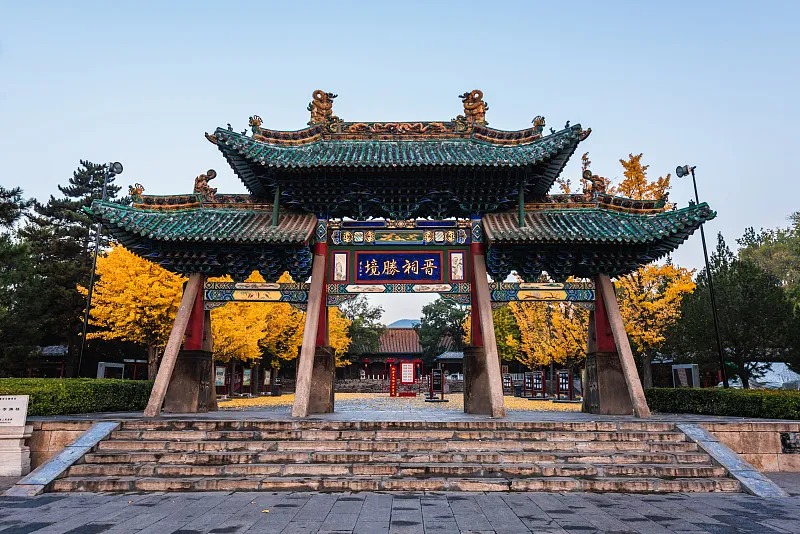
Located at the foot of Xuangweng Mountain in the southwest of Taiyuan, Jinci Temple is a royal temple and garden built to worship Tang Shuyu, the founding feudal lord of the Jin State in the Western Zhou Dynasty. With a history of more than 3,000 years, it is the earliest existing royal sacrificial garden in China, and there is a widely known saying: "He who has not been to Jinci Temple has not truly been to Taiyuan". First built in the Western Zhou Dynasty, it has been expanded and renovated through the Han, Wei, Northern Qi, Sui, Tang, Song, Yuan, Ming and Qing dynasties. Integrating ancient architecture, sculpture, stone inscriptions, garden art and spring landscapes, it is honored as "the Museum of Ancient Chinese Architectural Art".
The core landscapes of Jinci Temple are world-famous for its "Three Wonders": the Zhou Cypress, with a history of more than 2,800 years, still stands vigorous and upright after countless winds and rains, serving as a living witness of Western Zhou civilization; the Nanlao Spring, the source of the Jinshui River, flows continuously all year round with clear and sweet water, nourishing the thousand-year cultural context of Jinyang; the 43 painted clay statues of maids in the Hall of the Holy Mother from the Song Dynasty, each with distinct and vivid expressions and postures, represent the pinnacle of Song Dynasty court life depiction and sculpture art. In addition, the Yuzhao Feiliang (Fish Pond Flying Bridge), the earliest existing cross-shaped stone bridge in China, the Jin Dynasty Offering Hall, and the Tang Stele with the Inscription and Preface of Jinci Temple written personally by Emperor Taizong Li Shimin of the Tang Dynasty, are all national treasure-level cultural relics. Jinci Temple is not only a physical evidence of the patriarchal system of the Western Zhou Dynasty, but also a witness to major historical events such as the Partition of Jin by the Three Families. As the core carrier of Jinyang culture, it fully demonstrates the pinnacle achievements of ancient Chinese architectural craftsmanship and landscape garden aesthetics.
2. Yongzuo Temple
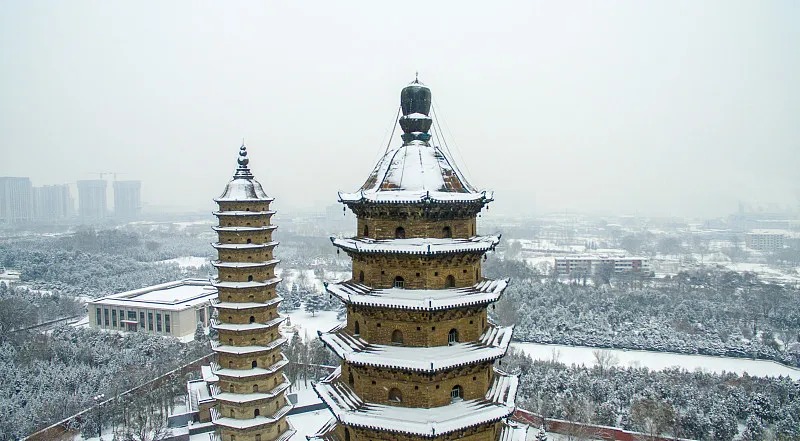
Yongzuo Temple, commonly known as the Twin Pagoda Temple, is located on the hills of Haozhuang in the southeast of Taiyuan. First built in the 27th year of the Wanli Reign of the Ming Dynasty (1599 AD), it is famous for the two towering twin pagodas standing side by side in the temple, serving as the urban landmark and spiritual symbol of Taiyuan. The scene of "Twin Pagodas Soaring into the Sky" ranks first among the Eight Ancient Scenes of Jinyang. The temple was built under the supervision of Master Miaofeng, an eminent monk of the Ming Dynasty. Built along the mountain terrain and facing north from the south, the entire building is constructed with blue bricks imitating wood structures without a single wooden beam, combining the grandeur of northern frontier architecture and the exquisite craftsmanship of official architecture of the Ming Dynasty. It is a model of brick structure architecture in the Ming Dynasty in China.
The two octagonal 13-story multi-eave brick pagodas in the temple, the East Wenfeng Pagoda and the West Xuanwen Buddha Pagoda, both stand 54.7 meters high, with symmetrical shapes and towering momentum. They have stood firm for more than 400 years despite earthquakes, wars and wind and rain erosion. The temple also houses the famous Ming Dynasty peony variety "Zixiaxian", one of the oldest existing peony varieties in China. Every spring when the peonies are in full bloom, it forms a magnificent scenery known as "the Twin Pagodas’ Peonies are the finest in Jinyang". Yongzuo Temple is not only the core holy land of Buddhist culture in Shanxi during the Ming and Qing dynasties, but also carries the cultural tradition of advocating literature and education in Taiyuan. Climbing up the pagoda, visitors can have a panoramic view of the whole city of Taiyuan. It is a witness to the rise and fall of Jinyang’s history in the Ming and Qing dynasties, and an iconic symbol of Taiyuan’s urban culture.
3. Tianlong Mountain Grottoes
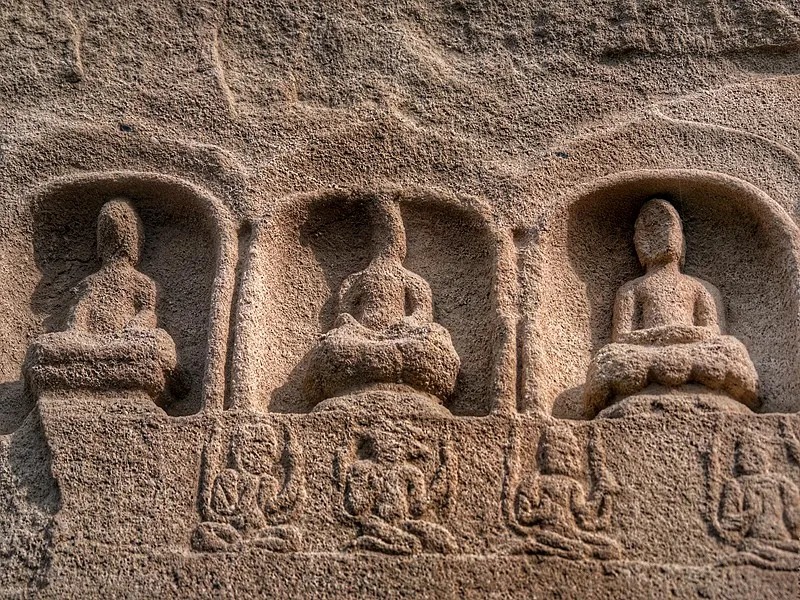
Located on the mountainside of Tianlong Mountain in the southwest of Taiyuan, the Tianlong Mountain Grottoes were first chiseled in the Wuding Reign of the Eastern Wei Dynasty, and were continuously excavated through the Northern Qi, Sui, Tang and Five Dynasties, with a construction history spanning more than 400 years. They are the essence of Chinese grotto art from the Northern Dynasties to the Sui and Tang dynasties, and an important node for the eastward spread of Buddhist art along the Silk Road. The existing grotto complex consists of 25 caves distributed on the cliffs of the east and west peaks, with more than 500 existing statues and 1,144 preserved reliefs, caissons and murals. The statue style integrates the characteristics of the Xianbei nationality, the Central Plains Han culture and the Western Regions Buddhist art, forming a unique "Tianlong Mountain Style".
Among them, more than half of the caves were built in the Tang Dynasty, especially the Maitreya Buddha and the Eleven-faced Avalokitesvara Statue in Cave 9 are the most famous. The Buddha statue is 8 meters high, with a plump face and solemn demeanor, fully showing the grace and grandeur of the Tang Dynasty statue art; the flying apsaras reliefs have light postures and smooth drapery lines, known as "the essence of oriental flying apsaras art". The grottoes also preserve the Stone Inscription of Avatamsaka Sutra from the period of Wu Zetian, which integrates Buddhist studies, calligraphy and stone carving art, and has extremely high historical value. The Tianlong Mountain Grottoes not only witnessed the historical process of the great national integration in the Northern Dynasties, but also completely presented the style evolution of Chinese Buddhist grotto art from the Northern Dynasties to the Sui and Tang dynasties. They are a treasure house of ancient Chinese sculpture art, carrying the thousand-year inheritance of Buddhist culture and art in Jinyang.
4. Mengshan Giant Buddha
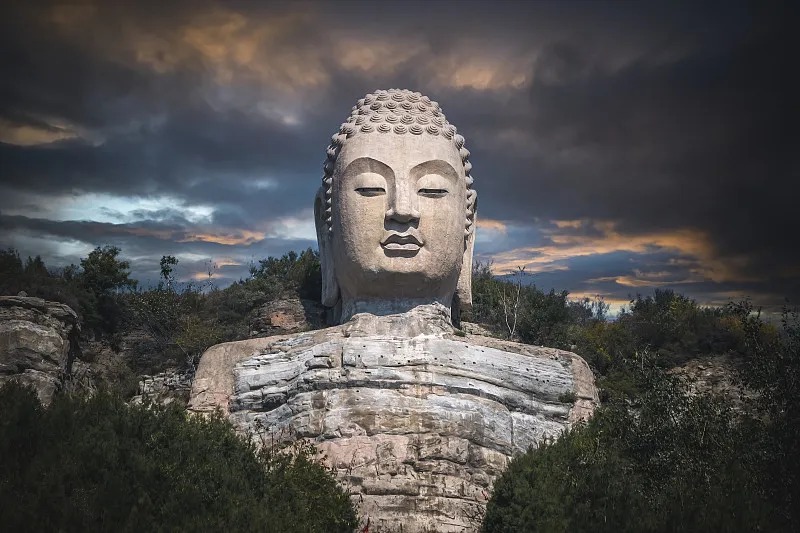
Located in the hinterland of Mengshan Mountain in the southwest of Taiyuan, the Mengshan Giant Buddha was first chiseled in the 2nd year of the Tianbao Reign of the Northern Qi Dynasty (551 AD). It is one of the earliest large-scale cliff-carved Buddha statues in the world, 162 years earlier than the Leshan Giant Buddha in Sichuan Province, and represents the pinnacle of Buddhist statue art of the Northern Qi Dynasty. Carved along the cliff, the statue is a seated statue of Sakyamuni, with an original total height of about 48 meters. The Buddha head alone is 12 meters high, with a plump and mellow face, a solemn and compassionate expression, broad shoulders and a magnificent momentum, fully showing the grandeur of the Northern Qi statue art.
Historically, Mengshan Mountain was the core religious and sacrificial area of the ancient Jinyang City, with its incense reaching its peak during the Sui and Tang dynasties. Emperors such as Li Yuan of the Tang Dynasty, Li Zhi and Wu Zetian of the Tang Dynasty, and Liu Zhiyuan of the Later Han Dynasty all visited here to worship the Buddha. Wu Zetian also specially customized a cassock for the Giant Buddha, which caused a sensation at that time. From the late Tang Dynasty to the Song and Yuan dynasties, the Buddha was gradually buried in the mountains and forests due to wars, natural disasters and landslides, and was not rediscovered until 1980. Around the Giant Buddha, there are also historical sites such as the site of the Sui Dynasty Kaihua Temple, the Twin Lotus Pagodas of the Song Dynasty, and the Iron Buddha Hall, surrounded by lush forests and a quiet environment. The Mengshan Giant Buddha is not only a precious physical relic for the study of Buddhist communication, statue art and Jinyang history of the Northern Qi Dynasty, but also a great masterpiece of stone carving craftsmanship of ancient Chinese working people, carrying the thousand-year Buddhist cultural memory of Jinyang.
5. Chunyang Palace
Chunyang Palace is located on the northwest side of Wuyi Square in the downtown area of Taiyuan. First built in the Zhizheng Reign of the Yuan Dynasty, it is a famous Taoist temple dedicated to Lü Dongbin, one of the Eight Immortals of Taoism. It is named after Lü Dongbin’s Taoist name "Chunyangzi", and now serves as the Shanxi Museum of Ancient Architecture. It is a rare and quiet ancient architectural secret in the busy downtown of Taiyuan. After several expansions and renovations in the Ming and Qing dynasties, the temple has formed an architectural system with the layout of the Nine Palaces and Eight Trigrams as the core, which is a rare existing Taoist temple complex in China built completely in accordance with the Taoist Eight Trigrams concept.
The overall building of Chunyang Palace is symmetrically arranged along the central axis, with four courtyards advancing layer by layer. Pavilions, terraces, corridors and halls are well-arranged, integrating the architectural styles of the Yuan, Ming and Qing dynasties. The wood carving, brick carving and stone carving techniques are exquisite and delicate, and the decorations on the roof ridges, screen walls, doors and windows all contain Taoist cultural images, fully demonstrating the exquisiteness of traditional Chinese architectural craftsmanship. The palace has an extremely rich collection of cultural relics, with more than 10,000 pieces of cultural relics from the Neolithic Age to the Ming and Qing dynasties, including stone carvings, sculptures, steles, bronzes, calligraphy and paintings. Among them, the iron lion of the Tang Dynasty, the stone statue of Lü Dongbin of the Yuan Dynasty, the painted Taoist statues of the Ming and Qing dynasties, and the calligraphy steles of past dynasties are all rare treasures. Historically, Chunyang Palace was the communication center of Taoist culture in Shanxi, and also a gathering place for literati in Taiyuan. Now it has integrated ancient architecture protection, cultural relics exhibition and cultural inheritance, becoming a cultural landmark in the center of Taiyuan, and witnessing the thousand-year inheritance and development of Taoist culture in Shanxi.
6. Taiyuan Ancient County Town
Located in Jinyuan District of Taiyuan, Taiyuan Ancient County Town was first built in the 8th year of the Hongwu Reign of the Ming Dynasty (1375 AD). It is a Ming and Qing county town built on the site of the ancient Jinyang City, completely continuing the 2,500-year historical context of the ancient Jinyang City. Because the layout of the whole city is like a spreading phoenix, it is known as the "Phoenix City", and is one of the few well-preserved Ming and Qing county town relics with complete layout existing in China.
The ancient county town covers an area of about 0.8 square kilometers, with a city wall circumference of more than 3,700 meters. It has a complete city layout, with a cross main street running through the whole city and more than 40 crisscrossing streets and lanes. It completely retains the county town regulation of "county government in the center, four main streets connected, crisscrossing streets and lanes, and shops lined up" in the Ming and Qing dynasties. Ancient buildings of the Ming and Qing dynasties, such as the county government office, Confucian Temple, Martial Temple, Town God’s Temple and Wudao Temple, stand in great numbers, with blue bricks and grey tiles, upturned eaves and corners, fully showing the grandeur of the northern ancient city and the exquisite elegance of Shanxi folk houses. Historically, it was an important commercial town and transportation hub in the south of Taiyuan Prefecture during the Ming and Qing dynasties, and an important distribution center for Jin Merchants traveling between the north and south of China, with a large number of commercial firms, exchange shops, pawnshops and taverns gathered here, boasting an extremely prosperous commercial and urban culture. Today, the ancient county town not only inherits intangible cultural heritage skills such as Jin Opera, Lianhualao folk art, paper cutting, dough modeling and aged vinegar brewing in a living state, but also became famous for the filming of well-known film and television works such as Full River Red. It has become a living carrier of Jinyang culture integrating historical sightseeing, cultural experience, intangible cultural heritage inheritance and urban leisure, and a vivid epitome of Taiyuan’s Ming and Qing history and Jin Merchant culture.

 English
 French
 Spanish
 Russian
 Arabic
 Italy
Italy